
- Home
- Dubai Travel Guide
- Dubai Language Guide for Indians: Useful Arabic & English Phrases for Tourists
- Dubai Travel Guide
- On 23.09.2026
- Lovanshu Tiwari
Dubai Language Guide for Indians: Useful Arabic & English Phrases for Tourists
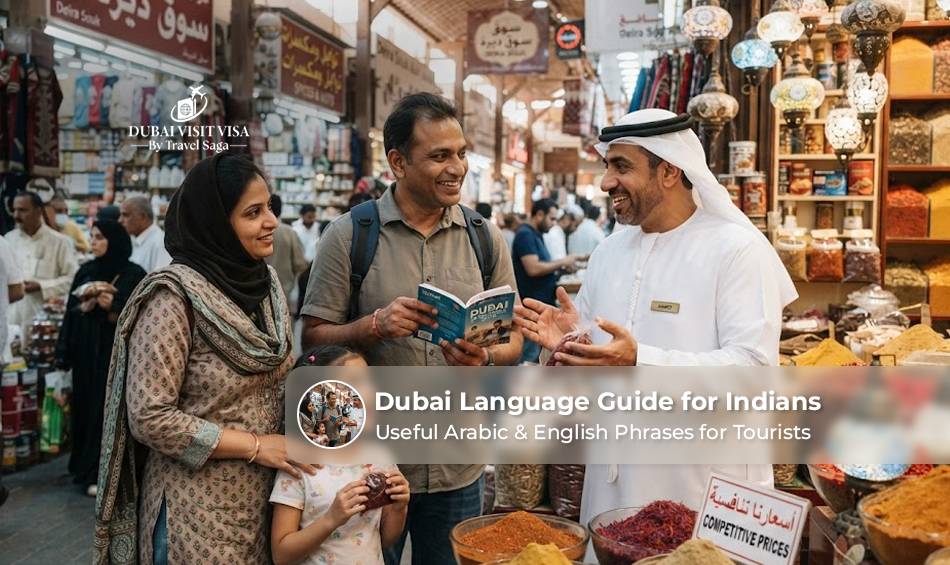
You do not need to speak Arabic to enjoy a holiday in Dubai. English is widely used across hotels, restaurants, shops, transport and tourist services, while Hindi and Urdu are also commonly heard because of Dubai’s large South Asian communities. Still, learning a few Arabic expressions can make everyday interactions warmer and easier. This guide covers useful Arabic and English phrases for Indian travellers, along with the words you are likely to hear during a typical Dubai holiday.
What Languages Are Actually Spoken in Dubai?
Dubai is one of the world’s most multilingual cities. You may hear several languages during a single taxi ride, restaurant visit or shopping trip.
Arabic: The Official Language of the UAE
Arabic is the official language of the UAE. It is used in government, official communication, public life and many formal settings. Visitors will also notice Arabic on road signs and commercial signs, usually alongside English. You therefore do not need to worry about being unable to understand the city simply because you cannot read Arabic. Learning a few words is more about cultural awareness than survival. Even a simple “shukran” can make a routine interaction feel more personal.
English: The De Facto Working Language for Tourism, Hotels, and Government Services
English is widely used throughout Dubai, particularly in tourism and business. Hotels, airports, restaurants, shopping centres and tourist attractions generally have English-speaking staff. Most visitors can therefore manage their entire holiday using English. You can ask for directions, order food, check into a hotel and arrange transport without knowing Arabic.
A Reassurance for Indian Travellers: Hindi and Urdu Are Widely Understood Too
Indian travellers may find Dubai especially easy linguistically. Visit Dubai’s current language guide specifically lists Hindi and Urdu among the languages spoken in the city, alongside Arabic and English. This does not mean every person you meet will speak Hindi or Urdu. However, you may encounter people who understand one of these languages in taxis, shops, restaurants and neighbourhood businesses. For many Indian tourists, this adds another layer of comfort during the trip.
Do You Really Need to Learn Arabic as an Indian Tourist?
The short answer is no. You can comfortably travel around Dubai using English, but knowing a few Arabic expressions is still worthwhile.
Menus, Signage, and Services Are Almost Always Bilingual
Arabic and English are commonly used together in Dubai’s public and commercial environment. The UAE government notes that road and traffic signs and commercial signs are presented in Arabic and English. Major hotels, malls and attractions also cater to international visitors, so English information is normally easy to find. That means your Arabic phrase list should be considered a bonus rather than a requirement.
Why Learning a Few Phrases Still Matters: It’s a Gesture of Respect, Not a Necessity
Using a local greeting or saying thank you in Arabic shows that you have made an effort to engage with the culture. You do not need perfect pronunciation. A friendly “marhaba” or “shukran” said naturally is enough. The goal is not to sound fluent. It is simply to use a few words confidently when the situation feels appropriate.
Essential Arabic Greetings
Start with greetings because they are the easiest phrases to use naturally during a holiday.
As-salam alaykum / Wa’alaykum as-salam: Formal Hello and Response
“As-salam alaykum” is a traditional greeting meaning roughly “peace be upon you”. The response is “wa’alaykum as-salam”. It is widely recognised and can be used respectfully in appropriate situations. If you are unsure, a simple “marhaba” is an easier everyday option.
Marhaba / Ahlan wa sahlan: Casual Hello and Welcome
“Marhaba” means hello and is one of the easiest Arabic words for visitors to remember. “Ahlan wa sahlan” is another welcoming expression you may hear in Dubai. It can feel more elaborate than a simple hello but is useful to recognise when someone says it to you.
Kayfa haluk / Kayfa haluki: How Are You?
“Kayfa haluk” is commonly given as a way to ask a man how he is, while “kayfa haluki” is used when addressing a woman. In everyday Dubai conversations, you may hear more informal variations. Do not worry if your pronunciation is not perfect; the intention matters more for a short tourist interaction.
Ma’a as-salama: Goodbye
“Ma’a as-salama” is a useful way to say goodbye. It is particularly handy after a meal, shopping interaction or conversation when you want to finish politely rather than simply walking away.
Practical Phrases for Everyday Situations
The phrases below are more useful when you are actually moving around Dubai.
Shopping and Bargaining: “Kam thaman hada?”
“Kam thaman hada?” means “How much does this cost?” You may find this useful in markets and traditional souks. In large shopping malls, prices are generally displayed clearly, so you are more likely to use the phrase in smaller shops or market environments. You can also remember “bi kam?” as a shorter way of asking the price.
Getting Around: “Wayn al-funduq?” and “Wayn al-mahattat al-metro?”
“Wayn al-funduq?” can be used to ask where the hotel is. “Wayn al-mahattat al-metro?” means roughly “Where is the Metro station?” You may not need either phrase because Dubai has extensive English signage and navigation apps, but knowing them can be useful when speaking with someone who prefers Arabic.
Dining: Ordering and Asking for the Bill
Restaurants in Dubai generally have English menus, especially in tourist areas. You can therefore order comfortably in English. A few Arabic courtesy words can still make the interaction more pleasant. “Min fadlak” means “please” when speaking to a man, while “min fadlik” is used when speaking to a woman. If you are unsure about pronunciation, simply use English politely. Clear communication is more important than forcing yourself to use Arabic.
Courtesy Words: Shukran, Afwan, Na’am and La
“Shukran” means thank you and is probably the single most useful Arabic word for tourists. “Afwan” can mean you’re welcome and is also used in other polite contexts. “Na’am” means yes, while “la” means no. These are short enough to remember before your flight and easy to use throughout a trip.
A Note for Indian Travellers on Hindi/Urdu Use
Indian travellers often find Dubai linguistically comfortable because of the city’s large South Asian population.
Where You’re Most Likely to Get By in Hindi or Urdu
You may encounter Hindi or Urdu in taxis, local shops, restaurants, markets and service businesses, although it should never be assumed that every person speaks either language. Dubai’s official tourism information confirms that Hindi, Urdu and other South Asian languages are spoken in the city. This can be particularly helpful if you are travelling with older family members who are less confident speaking English.
Why This Doesn’t Replace Basic Arabic Courtesy: Context Still Matters
Being able to speak Hindi or Urdu in some situations is convenient, but it is still worth learning basic Arabic courtesy words. A “shukran” or “marhaba” shows awareness of the local culture. At the same time, there is no need to overthink it. If English is easier, simply communicate clearly and politely. The best approach is to use whichever language makes the conversation comfortable for everyone involved.
Get Ready for Your Dubai Trip
Language should not be something that makes an Indian traveller nervous about visiting Dubai. English will usually get you through the trip, Hindi or Urdu may help in some everyday situations, and a handful of Arabic words can make your interactions feel warmer. Getting ready for your Dubai trip? Make sure your visa is sorted with the help of dubaivisitvisa.in.
FAQs – Dubai Language Guide for Indians
No. English is widely used across Dubai’s tourist infrastructure, including hotels, restaurants, shops and attractions. A few Arabic phrases are useful but not essential.
Hindi and Urdu are among the languages spoken in Dubai, and Indian travellers may encounter speakers in many everyday settings. However, availability varies from person to person.
“Shukran”, meaning “thank you”, is one of the easiest and most useful words to remember. “Marhaba”, meaning hello, is another good starting point.
Many tourist-facing signs, menus and services are available in English. UAE government information also confirms that road and traffic signs and commercial signs are presented in Arabic and English.
Generally, English is widely used in Dubai, so visitors can comfortably communicate in English. Using a few Arabic courtesy words can be a nice cultural gesture, but it is not a requirement. For more visa related questions, go through our FAQs section.
Visit our office- Get Directions